No QE3 but Bernanke gives some hope

Not only did Federal Reserve Chairman Bernanke not discuss the potential for more quantitatiive easing QE3 but he also did not discuss many other options for Fed policy at Jackson Hole last Friday. The onus has now shifted to the 2-day Fed FOMC meeting on September 21 where markets are looking (hoping) for fresh policy measures. Such hopes helped US equity markets bounce back after initially reacting negatively to Bernanke’s speech.

Bernanke provided some hope to markets that the US economy wasn’t sliding into the abyss while offering the potential for further Fed stimulus even if QE3 wasn’t quite on the cards. This hope was sufficient to spur markets higher. However, importantly Bernanke noted the limitations of monetary policy in stimulating growth over the medium term.

In this respect there will be plenty of attention on President Obama’s speech on September 5 in which markets will be looking for a response from the administration at a time when the economy is becoming an increasingly important issue for the electorate.

In the meantime there are plenty of data releases to contend with this week including the August US jobs report, ISM manufacturing survey, US consumer confidence and various confidence surveys in Europe. Unfortunately the news will not be positive as the data releases are set to reinforce concerns of economic slowdown. The US jobs report is likely to reveal a limited, around 75k increase in non-farm payrolls according to consensus while the ISM manufacturing survey is set to drop into contraction territory.

Consequently markets may start the week in risk on mood but this is unlikely to last given renewed economic worries. Moreover, Eurozone peripheral country travails continue to exasperate markets, with concerns that some members of German Chancellor Merkel’s coalition plan to vote against the revamped EFSF bailout fund and news that two German banks have yet to commit on Greece’s bailout plan. Against this background the EUR continues to defy gravity around the 1.45 level versus USD but may yet come down to earth with a bang.
US Ratings Under Threat

The USD succumbed to further pressure overnight as Moody’s Investor Service threatened to place the US Aaa rating on review for downgrade if there is no agreement reached on raising the US debt ceiling. Although the news prompted a rise in US Treasury yields it did little for the USD.

News that the Federal Reserve’s balance sheet expanded to a record $2.772 trillion in the week ending June 1 highlights the ongoing headwinds to the USD from Fed asset purchases. The fact that there is even talk of QE3 in the wake of weak US data suggests that the headwinds will not dissipate quickly.

Direction today will come from the US May jobs report though this is unlikely to deliver any good news for the USD. Forecasts for non-farm payrolls have likely been revised lower to sub 100k compared to the published consensus forecast of 165k following the weaker indications from the May ADP jobs report and ISM data this week. A weak payrolls outcome will only intensify worries about the depth and length of the US ‘soft patch’.

Although market expectations are also likely to have been downwardly revised, something that may cushion the blow to the USD, it will be difficult to get away from the fact that growth in Q2 is weaker than many had thought.

EUR was well supported overnight, boosted by a relatively successful Spanish bond auction yesterday and reports that officials have agreed in principle to a 3-year adjustment plan for Greece covering funding needs to 2013 although there was no confirmation of such an agreement.

As a result, EUR/USD tested 1.45 and looks supported ahead of today’s US payrolls data. EUR’s recovery in general has been impressive but gains above 1.45 are likely to prove more difficult even if an agreement on Greece is close to being achieved.

As usual Japan’s political gyrations are having little impact on the JPY as the currency is instead buffeted by risk aversion swings and yield differentials. In fact USD/JPY has been rather well behaved over recent weeks as indicated by implied options volatility.

Prime Minister Kan’s success in winning a no-confidence motion came at a cost and may provide very little political stability. Kan said will resign as soon as post-earthquake recovery efforts are completed and once he is gone there is likely to be some realignment of existing political parties.

As for the JPY it will remain unscathed by political events. Over the near term USD/JPY is likely to cling to the 81 handle but we maintain our bearish view on the JPY in the medium term under the assumption that there is a sharp widening in US – Japan bond yield differentials.

US Economic Data Disappointments

Risk gyrations continue, with a sharp shift back into risk off mood for markets driven in large part by yet more disappointing US economic data as the May ADP jobs report came in far weaker than expected at 38k whilst the ISM manufacturing index dropped to 53.5 in May, its lowest reading since September 2009. This was echoed globally as manufacturing purchasing managers indices (PMI) softened, raising concerns that the global ‘soft patch’ will extend deeper and longer than predicted.

The market mood was further darkened by news that Moodys downgraded Greece’s sovereign credit ratings to Caa1 from B1, putting the country on par with Cuba and effectively predicting a 50% probability of default.

The resultant jump in risk aversion was pretty extensive, with US Treasury yields dipping further, commodity prices dropping led by soft commodities, and equity volatility spiking although notably implied currency volatility has remained relatively well behaved.

Global growth worries led by the US have now surpassed Greek and eurozone peripheral country concerns as the main driver of risk aversion, especially as it increasingly looks as though agreement on a further bailout package for Greece is moving closer to being achieved. Moreover, it seems as though a ‘Vienna initiative’ type of plan is moving towards fruition involving a voluntary rollover of debt.

The lack of first tier economic data releases today suggests that it will be a case of further digestion or perhaps indigestion of the weak run of US data releases over recent weeks and the implications for policy. For instance, it is no coincidence that QE3 is now being talked about again following the end of QE2 although it still seems very unlikely.

Bonds may see some respite from the recent rally given the lack of data today although this may prove short-lived as expectations for the May US jobs report tomorrow are likely to have been revised sharply lower in the wake of the weak ADP jobs data and ISM survey yesterday, with an outcome sub 100k now likely for May US non-farm payrolls.

Meanwhile, FX markets are caught between the conflicting forces of higher risk aversion and weaker US data, leaving ranges to dominate. On balance, risk currencies will likely remain under pressure today and the USD may get a semblance of support in the current environment.

This may be sufficient to prevent EUR/USD from retesting its 1 June high around 1.4459 as markets wait for further developments on the Greek front. Once again the likes of the CHF and to a lesser extent JPY will do well in a risk off environment whilst the likes of the AUD and NZD will suffer.

Position Unwinding Boosts USD

The USD’s multi-month fall has come to an abrupt halt, with the currency registering gains in reaction to what appears to be a major position unwinding across asset markets, led by a drop in commodity prices.

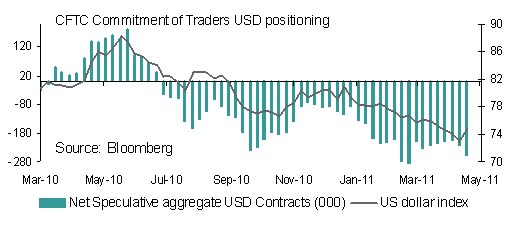
Will it continue? Whilst I am amongst the more bullish forecasters on the USD over the medium term, the current rally could prove to be short-lived in the absence of a shift in Federal Reserve rhetoric or end to quantitative easing (QE2). Nonetheless, the market had got itself very short USDs (as reflected in the CFTC IMM data as of early last week which showed an increase in net short positions) and the rally in the USD last week was likely spurred by major short-covering which could extend further into this week.

The move in the USD gained momentum as European Central Bank (ECB) President Trichet proved to be less hawkish than many expected in the press conference following last Thursday’s ECB meeting. Moreover, renewed worries about Greece at the end of last week, with a report in the German Der Spiegel, later denied by Greek officials, that the country was planning to leave the Eurozone dented the EUR,

Taken together with the improving trend in US April non-farm payrolls (April registered +244k increase, with private payrolls 268k), these factors colluded to provide further positive stimulus to the USD and negative fallout on the EUR. The room for EUR downside is evident in the net long EUR speculative position, which rose to its highest since December 2007 as of 3rd May.

This week’s batch of US releases including March trade data, April retail sales and CPI, are unlikely to result in a reversal in last week’s trend though a trend like reading for core CPI, with the annual rate below the Fed’s comfort zone will reinforce expectations of dovish Fed policy being maintained, which could inject a dose of caution into the USD’s rally.

Against the background of a likely widening in the US trade deficit in March there will plenty of attention on the annual strategic and economic dialogue beginning today, with markets interested in discussions on Chinese worries about the gaping US fiscal deficit and US concerns about China’s exchange rate policy.

Greece’s denial of plans to leave the eurozone and discussions over a further adjustment to Greece’s bail out package, may help limit any drop in the EUR this week though it will by no means mark the end of such speculation about the periphery especially with this weeks’ Q1 GDP data releases across the eurozone likely to further highlight the divergence between the core and the periphery even if the headline eurozone reading rebounds strongly as we expect.

In the UK the Bank of England Quarterly Inflation Report will be the main influence on GBP. Downward growth revisions will play into the view that inflation will eventually moderate, capping expectation of higher interest rates over the coming months. However, the likely upward revision to near term inflation forecasts will help limit any damage to GBP.

GBP has lost ground to the USD but it should be noted that it has outperformed the EUR over recent days, reversing some of the recent run up in EUR/GBP. Given that EUR sentiment is likely to remain fragile this week, GBP may continue to capitalise, with a test of EUR/GBP 0.8672 on the cards.

Risk Aversion Creeps Higher

The USD index has dropped by around 17% since June 2010 high and despite a slight bounce this week it is unlikely to mark the beginning of a sustained turnaround. Nonetheless, I would caution about getting carried away with positioning for USD weakness. Whilst an imminent recovery looks unlikely the risk/reward of shorting the USD is becoming increasingly unfavourable.

Until then Federal Reserve comments will be watched closely for clues on policy and there are plenty of Fed speakers this week including a speech by Boston Fed’s Rosengren today and Fed Chairman Bernanke tomorrow. The USD will also gain some direction from jobs data and markets will be able to gauge more clues for Friday’s non-farm payrolls data , with the release of the April ADP employment report today.

The EUR is one currency that has suffered this week. News that Portugal’s caretaker government has reached an agreement with the European Union / International Monetary Fund on a bailout of as much as EUR 78 billion has so far been greeted with a muted response. EUR attention is still very much focussed on the ECB meeting tomorrow and prospects of a hawkish press statement suggest that EUR/USD downside will be limited, with support seen around 1.4755.

The JPY has strengthened by around 5% versus USD since its 6th April USD/JPY high around 85.53, confounding expectations that Japan’s FX intervention following the county’s devastating earthquake marked a major turning point in the currency. A combination of narrowing interest rate differentials with the US (2 year US/Japan yield differentials have narrowed by around 20bps in the past month), strong capital inflows to Japan (net bond and equity flows in the last four weeks have increased to their highest this year), and rising risk aversion have all played their part in driving the JPY higher.

As a result USD/JPY is fast approaching the psychologically important level of 80, a level that if breached will likely lead to FX intervention. Although Golden Week holidays in Japan this week suggest that JPY liquidity may be quite thin, Japanese authorities are likely to remain resistant to further gains in the JPY, likely using thinning liquidity to their advantage.

Despite the JPY’s recent strength speculative positioning over the past four weeks has remained net short JPY, whilst Japanese margin traders have also increased their long USD/JPY bets, suggesting that these classes of investors are not to blame for the JPY’s appreciation. This suggests that FX intervention may not be as successful given that the market is already short JPY.

Given the risk of intervention on USD/JPY, the CHF appears to be an easier choice for safe haven demand against the background of rising risk aversion. The currency has risen to a record high against the USD, gaining around 8.3% so far this year. Given the hints of higher interest rates by the Swiss National Bank (SNB) and resilience economic performance, downside risks for CHF are limited at present unless risk appetite improves sharply. Further gains are likely with USD/CHF likely to test the 0.8570 support level over the short-term.