US Economic Data Disappointments

Risk gyrations continue, with a sharp shift back into risk off mood for markets driven in large part by yet more disappointing US economic data as the May ADP jobs report came in far weaker than expected at 38k whilst the ISM manufacturing index dropped to 53.5 in May, its lowest reading since September 2009. This was echoed globally as manufacturing purchasing managers indices (PMI) softened, raising concerns that the global ‘soft patch’ will extend deeper and longer than predicted.

The market mood was further darkened by news that Moodys downgraded Greece’s sovereign credit ratings to Caa1 from B1, putting the country on par with Cuba and effectively predicting a 50% probability of default.

The resultant jump in risk aversion was pretty extensive, with US Treasury yields dipping further, commodity prices dropping led by soft commodities, and equity volatility spiking although notably implied currency volatility has remained relatively well behaved.

Global growth worries led by the US have now surpassed Greek and eurozone peripheral country concerns as the main driver of risk aversion, especially as it increasingly looks as though agreement on a further bailout package for Greece is moving closer to being achieved. Moreover, it seems as though a ‘Vienna initiative’ type of plan is moving towards fruition involving a voluntary rollover of debt.

The lack of first tier economic data releases today suggests that it will be a case of further digestion or perhaps indigestion of the weak run of US data releases over recent weeks and the implications for policy. For instance, it is no coincidence that QE3 is now being talked about again following the end of QE2 although it still seems very unlikely.

Bonds may see some respite from the recent rally given the lack of data today although this may prove short-lived as expectations for the May US jobs report tomorrow are likely to have been revised sharply lower in the wake of the weak ADP jobs data and ISM survey yesterday, with an outcome sub 100k now likely for May US non-farm payrolls.

Meanwhile, FX markets are caught between the conflicting forces of higher risk aversion and weaker US data, leaving ranges to dominate. On balance, risk currencies will likely remain under pressure today and the USD may get a semblance of support in the current environment.

This may be sufficient to prevent EUR/USD from retesting its 1 June high around 1.4459 as markets wait for further developments on the Greek front. Once again the likes of the CHF and to a lesser extent JPY will do well in a risk off environment whilst the likes of the AUD and NZD will suffer.
Risk on, risk off

The USD has lost some upward momentum as risk appetite improved but FX markets remain skittish as sentiment gyrates between ‘risk on’ and ‘risk off’. The fact that US Q1 GDP was left unrevised whilst jobless claims surprisingly increased together with ongoing Greece concerns suggests that a risk off mood may filter into markets despite positive US earnings. Although the USD has not particularly benefitted from any rise in risk aversion lately, worries about the next IMF tranche being withheld from Greece will likely play more positively for the USD.

Nonetheless, lurking in the background and helping to keep the USD restrained is the Fed’s ongoing asset purchases as QE2 remains in place until the end of June. Moreover US data disappointments points to risks that the Fed will only slowly embark on its exit strategy. Additionally any agreement towards extending the US debt ceiling appears to be far off, and threatens to go down to the wire all the way to August 2. US debt markets and the USD appear to be downplaying this issue at present but it remains a clear threat to US markets.

Continuing to limit any upside in the EUR is the fact that officials and markets continue to gyrate on whether Greece will or will not restructure its debt. Apparent divisions between the view of some officials and the ECB are adding to the confusion whilst fresh worries about the IMF withholding funding for Greece will likely keep EUR/USD capped.

Peripheral worries as well as growth concerns are clearly weighing on confidence and a broad based decline in economic and business confidence in various eurozone May measures is expected to be revealed in data today . Weaker data taken together with ongoing concerns about the eurozone periphery will likely see the EUR struggle, with the currency set to settle into a range versus USD over the short-term, with technical support around 1.3968 and resistance at 1.4210.

The loss of USD momentum has also been exhibited in USD/JPY which has turned lower following its recent upward move hitting a low around 81.09. The big news was the fact that April nationwide core CPI recorded its first YoY increase since December 2008. At the margin may reduce the pressure on the Bank of Japan (BoJ) to enact more aggressive policy measures, which in turn is positive for the JPY. A big factor contributing to keeping the JPY supported over recent weeks is the ongoing inflow of foreign capital into Japan’s bond and equity markets, with Japan recording six straight weeks of net inflows.

USD/JPY is one currency pair where the correlation with US – Japan 2-year bond yield differentials is holding up well over the past 3-months. The fact that the yield differential has dropped to its lowest level since November 2010 at around 30bps reveals the declining US yield advantage, and plays for a lower USD/JPY. Against this background the JPY is likely to remain supported in the short-term, but will find it tough to break through technical support around USD/JPY 80.15.

Eurozone peripheral tensions

The USD index remains under pressure but will likely continue to consolidate. The USD continues to be undermined by adverse interest rate differentials and is gaining little support from rising risk aversion. One factor that will help dictate USD direction over coming months is the prospects for further quantitative easing once QE2 ends.

Fed officials offered varied views on the subject. Dallas Fed President Fisher hinted he would support cutting short asset purchases before the end of June, whilst Atlanta Fed President Lockhart noted he was “very cautious” about further asset purchases. Meanwhile Chicago Fed President Evans noted that he believes the hurdle for altering the asset purchase plan is “pretty high”.

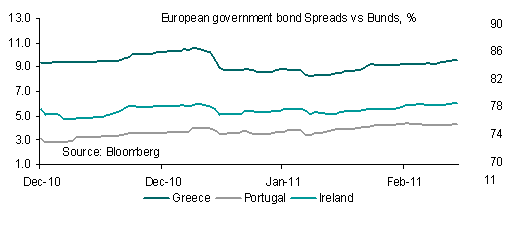
Although there is a lack of first tier data releases in the eurozone this week there is certainly plenty for markets to chew on in terms of peripheral country issues, which may just prevent the EUR from extending its gains. Eurozone peripheral debt spreads have undergone a renewed widening over recent weeks as debt fears have increased and worries that Portugal may follow Ireland and Greece in needing a bailout have risen.

Meanwhile news that Ireland’s incoming government will introduce legislation allowing the restructuring of some senior bank bonds, will add to tensions. Meanwhile, the downgrading of Greece’s government bond ratings to B1 from Ba1 dealt another blow sentiment following hot on the heels of Fitch’s downgrade of Spain’s outlook to negative although the EUR proved resilient to the news. EUR/USD continues to look as though it will consolidate around the 1.4000 level, but worsening sentiment towards the periphery may open up downside as the EUR’s resilience fades.

Upward revisions to eurozone growth and inflation forecasts and of course a hawkish shift in eurozone interest rate expectations may have justified the EUR move higher over recent weeks. However, there does not seem to be much that will provide the stimulus for further gains from current levels.

The market has already priced in an interest hike as early as next month’s European Central Bank (ECB) meeting and further tightening thereafter. The risk now appears asymmetric skewed to the downside especially if tensions between the eurozone core and peripheral countries deepen. How long the EUR can ignore such tensions?

It’s not only the eurozone periphery that should worry about ratings. Japan’s ratings agency R&I has warned that it may be forced to cut Japan’s sovereign ratings before April’s local elections due to current political problems. R&I’s concern revolve around the potential for political problems to delay fiscal reforms. As usual the JPY remains unmoved by political issues and is moving to the stronger side of its recent range against the background of elevated risk aversion.

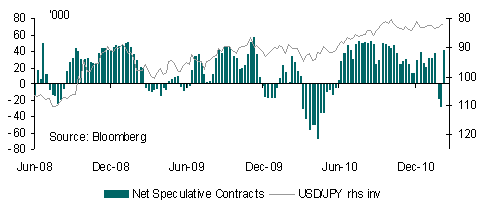
Although the JPY has not been particularly sensitive to risk over recent months shorter-term correlations shows that its sensitivity has increased. Given that Middle-East tensions do not appear to be easing the JPY will remain well supported. Indeed, speculative positioning data reveals the highest JPY net long position since November 2010. As risk appetite improves JPY positioning will be pared back but this is unlikely to be imminent, with USD/JPY set to remain close to support around 81.10.

Euro Sentiment Jumps, USD Sentiment Dives

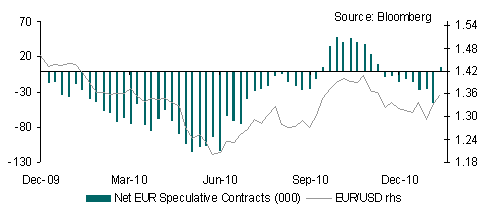
The bounce in the EUR against a broad range of currencies as well as a shift in speculative positioning highlights a sharp improvement in eurozone sentiment. Indeed, the CFTC IMM data reveals that net speculative positioning has turned positive for the first time since mid-November. A rise in the German IFO business confidence survey last week, reasonable success in peripheral bond auctions (albeit at unsustainable yields), hawkish ECB comments and talk of more German support for eurozone peripheral countries, have helped.

A big driver for EUR at present appears to be interest rate differentials. In the wake of recent commentary from Eurozone Central Bank (ECB) President Trichet following the last ECB meeting there has been a sharp move in interest rate differentials between the US and eurozone. This week’s European data releases are unlikely to reverse this move, with firm readings from the flash eurozone country purchasing managers indices (PMI) today and January eurozone economic sentiment gauges expected.

Two big events will dictate US market activity alongside more Q4 earnings reports. President Obama’s State of The Union address is likely to pay particular attention on the US budget outlook. Although the recent fiscal agreement to extend the Bush era tax cuts is positive for the path of the economy this year the lack of a medium to long term solution to an expanding budget deficit could come back to haunt the USD and US bonds.

The Fed FOMC meeting on Wednesday will likely keep markets treading water over the early part of the week. The Fed will maintain its commitment to its $600 billion asset purchase program. Although there is plenty of debate about the effectiveness of QE2 the program is set to be fully implemented by the end of Q2 2011. The FOMC statement will likely note some improvement in the economy whilst retaining a cautious tone. Markets will also be able to gauge the effects of the rotation of FOMC members, with new member Plosser possibly another dissenter.

These events will likely overshadow US data releases including Q4 real GDP, Jan consumer confidence, new home sales, and durable goods orders. GDP is likely to have accelerated in Q4, confidence is set to have improved, but at a low level, housing market activity will remain burdened by high inventories and durable goods orders will be boosted by transport orders. Overall, the encouraging tone of US data will likely continue but markets will also keep one eye on earnings. Unfortunately for the USD, firm US data are being overshadowed by rising inflation concerns elsewhere.

Against the background of intensifying inflation tensions several rate decisions this week will be of interest including the RBNZ in New Zealand, Norges Bank in Norway and the Bank of Japan. All three are likely to keep policy rates on hold. There will also be plenty of attention on the Bank of England (BoE) MPC minutes to determine their reaction to rising inflation pressures, with a slightly more hawkish voting pattern likely as MPC member Posen could have dropped his call for more quantitative easing (QE). There will also be more clues to RBA policy, with the release of Q4 inflation data tomorrow.

Both the EUR and GBP have benefitted from a widening in interest rate futures differentials. In contrast USD sentiment has clearly deteriorated over recent weeks as highlighted in the shift in IMM positioning, with net short positions increasing sharply. It is difficult to see this trend reversing over the short-term, especially as the Fed will likely maintain its dovish stance at its FOMC meeting this week. This suggests that the USD will remain on the back foot.

Temporary Euro Relief

Eurozone peripheral country travails continue to garner most market attention. There was at least a semblance of improvement on this front as peripheral bond spreads with German bunds narrowed on Tuesday but this was largely due to European Central Bank (ECB) bond buying than any improvement in sentiment. The fact that German bund yields also rose helped to narrow bund-peripheral spreads further.

A clearer test of sentiment will be today’s debt sales by Portugal followed by actions by Spain and Italy tomorrow. ECB buying of Portuguese bonds has given some relief to other debt, with Spanish and Italian debt spreads narrowing too. Even Greece managed to sell short term debt (EUR 1.95 bn of 26 week T-bills) but at a higher cost than the previous sale.

Perhaps a stronger boost to sentiment will come from the news that European Union (EU) governments are discussing an increase in the EUR 440 billion bailout fund in recognition of the fact that the fund may prove too small to cope if the crisis spreads to Spain. However, don’t expect a decision anytime soon, with next week’s meeting of EU finance ministers unlikely to agree to such a move. Support (or lack) of from Germany may prove to be a sticking point against the background of domestic political pressure.

Other options being considered include the possibility of the EFSF (European Financial Stability Facility) purchasing bonds in the secondary market and lowering interest rates on EFSF bailout loans. News that Japan will buy 20% of EFSF bonds this month as well as recent supportive comments from China suggest that an increase in the size of the EFSF may be easily funded by such investors. The EUR will gain some support against the background of such speculation but its upside may be restrained around its 200-day moving average at EUR/USD 1.3071.

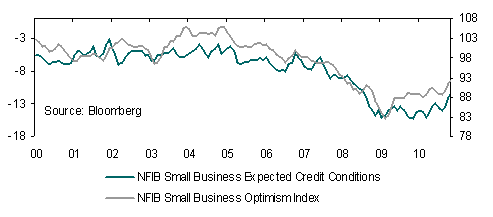
In the US the economic news was not so positive for a change as the National Federation of Independent Business (NFIB) small business optimism survey came in weaker than expected in December, an outcome that will come as a blow given that it suggests some stuttering in the recovery process as well as hiring.

There is only secondary data scheduled today, with most attention on the Fed’s Beige Book later tonight. The survey of Federal Reserve districts will likely reveal a broad based but moderate improvement in economic conditions with the exception of housing activity. A speech by the Fed’s Fisher on Monetary policy will also be in focus. Like the Fed’s Plosser overnight he may highlight some caution about the impact of Fed quantitative easing (QE).

The AUD is increasingly feeling the impact of the flooding in Queensland Australia as the extent of economic damage is revealed. Reserve Bank of Australia (RBA) board member McKibbin estimated that it could knock off at least 1% from economic growth. This may prove too negative and although the flooding will result in a significantly negative impact on growth in Q1 rebuilding and reconstruction will mean that overall growth for 2011 will not be as significantly impacted. Nonetheless, a paring back in RBA policy tightening expectations will see the AUD come under further pressure, with a move down to around AUD/USD 0.9634 on the cards over the short-term.