USD, EUR and JPY Outlook This Week

The USD lost more ground last week extending its drop from the early October. Interestingly its latest drop has occurred despite an uptick in risk aversion suggesting other factors are at work. Mixed US data and earnings have not given the USD much direction with a downbeat Beige Book counterbalanced by a firmer Philly Fed manufacturing survey and housing starts.

The data have not been sufficiently weak to fuel expectations of more Fed quantitative easing but some Fed officials including Yellen, Tarullo, Evans and Rosengren in indicating that further QE could be considered. The USD has therefore been somewhat undermined but will take its cue from data releases and events in Europe this week.

This data slate will be mixed but on balance will not support more Fed QE. In particular, Q3 Real GDP is expected to come in sharply higher than in Q2, with a 2.5% annual rate expected to be revealed. Other indicators will be less positive, with October consumer confidence set to slip further and remain at a recessionary level, while September durable goods orders will decline by around 1%.

Despite an expected increase in new home sales in September the overall picture of the US housing market will remain very weak. Overall, the USD may find some respite from the GDP report but the data will be seen as backward looking, with the jury still out on the issue of more quantitative easing.

The EUR struggled to make any headway last week amid a barrage of rumors about the outcome of Sunday’s EU Summit. In the event the summit failed to deliver concrete details although there appeared to be some progress in key areas. Attention will now turn to Wednesday’s summit but once again the risk of disappointment is high. EUR/USD will only extend gains if markets are satisfied at the result but this is by no means guaranteed.

Data releases will not be supportive for the EUR this week, with a further deterioration in ‘flash’ eurozone purchasing managers indices (PMIs) and European Commission confidence surveys expected in October but hopes of a concrete resolution at Wednesday’s EU Summit will keep the EUR/USD supported early in the week although it will find strong resistance around 1.3915.

The sensitivity of the JPY to risk aversion has actually fallen over the last three months while the influence of bond yield differentials also appears to have slipped. The fact that USD/JPY continues to remain in a very tight range with little inclination to break in either direction despite gyrations in risk and yield differentials almost appears if the currency pair has been pegged.
Obviously this is not the case but a break out of the current range does not look imminent.

Speculative JPY positioning has dropped over recent weeks while equity and bond flows have overall been negative but this has not been reflected in JPY weakness resulting in increased frustration by Japanese officials. We continue to look for the JPY to weaken over coming months but much will depend on a widening in US / Japan yield differentials and easing risk appetite as both will regain their hold on the currency. In the meantime, the currency will continue to offer little to get excited about.
Risk appetite remains fragile

The stabilisation in risk appetite over recent days looks highly fragile and markets will look to upcoming events in Europe and data releases to determine whether a rally in risk assets is justified. Discussions over the weekend between German Chancellor Merkel and French President Sarkozy delivered little in substance apart from a promise that a concrete response to the crisis will be delivered by the end of the month ahead of the 3 November G20 summit.

Both leaders agreed on the need for European banking sector recapitalisation and this issue along with whether or how to leverage the EFSF bailout fund and the extent of private sector participation in any Greek bailout is likely to take growing prominence for markets over coming weeks ahead of the EU summit on 17-18 October. In the meantime, markets may give Eurozone officials the benefit of the doubt but patience will run thin if no progress is made on these fronts.

The US jobs report at the end of last week which revealed a bigger than expected 103k increase in payrolls and upward revisions to previous months will have helped to allay fears about a renewed recession in the US and global economy. Indeed, recent surveys reveal that analysts expected weak US growth rather than recession. This week’s data will help to shore up such expectations with US data including retail sales and consumer confidence likely to outshine European data, including likely declines in industrial production in the region.

Overall, this will help to buoy risk appetite which may leave the USD with less of a safe haven bid but at the same time it will also reduce expectations of more quantitative easing (QE3) in the US, something that will bode well for the USD. Markets are set to begin the week in relatively positive mood but we remain cautious about the ability of risk appetite to be sustained. On balance, firmer risk appetite will play negatively for the USD early in the week but any drop in the USD will be limited by the fragility of risk appetite and potential for risk aversion to intensify again.

Fed does the Twist, markets do the Shake

Although it was widely expected the Federal Reserve’s decision to implement a fresh version of Operation Twist together with a downbeat assessment of the economy came as a disappointment to equities and risk assets in general. The only surprise was the larger size of the operation at $400 billion.

Moody’s downgrade of three US banks added to the malaise as US equities dropped sharply, commodities slid, longer term Treasuries rallied whilst shorter term bonds dropped. The USD registered broad gains both on the back of the fact that no more quantitative easing was announced and due to a shift away from risk assets. At least there was no more negative news out of the eurozone as talks between the Troika (ECB, IMF, EC) and Greek officials continue on the next tranche of the bailout.

Markets will continue to digest the Fed’s outcome today and the negative tone will likely filter through markets today. There is little on the data front to result in a shift in this tone. In the US data includes weekly jobless claims while in Europe attention will be on manufacturing and service sector confidence measures.

While the potential for a positive outcome to talks in Greece may provide a short term boost to sentiment the overwhelming tone is likely to remain negative especially as Operation Twist is unlikely to change the dynamic of a weak growth trajectory for the US and developed economies over the coming months. Against this background, selling risk assets on rallies remains the preferred option.

The USD will continue to look firmest against high beta emerging market currencies in the current environment. Currencies in this group are those that have the highest correlations with risk (as m measured by my in house risk barometer) over the past 3 months including CAD, ZAR, TRY, INR, MXN, ARS & RUB. In contrast currencies that also have high correlations but actually strengthen as risk aversion increases are CNY and JPY.

Euro fails too hold on to gains

Any improvement in sentiment following the USD liquidity support announcement by various central banks last week is already filtering away against the background of European Union (EU) officials’ failure to make any headway at the Ecofin meeting over the weekend, a delay in the approval of the next bailout tranche for Greece and ongoing collateral dispute between Greece and Finland. On top of all of this German Chancellor Merkel suffered a further setback in regional elections over the weekend.

Greece will remain in focus this week and markets will look for signs that the country is back on track on its austerity plans and its next loan tranche. Prime Minister Papandreou cancelled a trip to the US while the Greek cabinet are apparently deciding on new fiscal measures. Attention will turn to a teleconference today from the Greek Finance Minister with EU and IMF officials.

Speculative sentiment for the EUR has already soured further and according to the latest CFTC IMM report, positioning in EUR is at its lowest since the end of June 2010. EUR/USD will continue to look very vulnerable having already dropped sharply from a high of around 1.3899 in Asian morning trading as the bad weekend news hit the currency. EUR/USD will find some technical support just below 1.3500 this week but any upside is set to prove limited unless some concrete announcements are delivered relating to Greece over coming days.

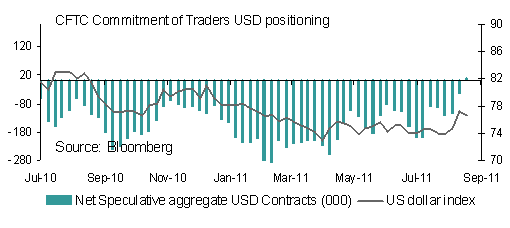
In contrast to the EUR, USD speculative appetite has turned net long for the first time since July 2010. The extended Fed FOMC meeting will help to dictate USD sentiment as markets wait for further measures to stimulate the economy. The Federal Reserve has already committed to hold rates steady until at least mid 2013 and the extended two day meeting this week will likely discuss further options. However, more quantitative easing (QE3) appears unlikely at this stage while an ‘Operation Twist’ type approach is more probable. The USD will benefit from a lack of further quantitative easing but this is largely already priced in.