Euro still looks uglier than the dollar

Currency markets continue to vacillate between US debt ceiling concerns and eurozone peripheral debt worries. Despite a lack of agreement to raise the debt ceiling, with House Republicans failing to back a proposal by House speak Boehner, the USD actually strengthened towards the end of the week as eurozone peripheral issues shifted back into focus.

The resilience of the USD to the lack of progress in raising the debt ceiling is impressive and reveals that the EUR looks even uglier than the USD, in many investors’ eyes.

Much in terms of direction for the week ahead will depend on the magnitude of any increase in the debt ceiling and accompanying budget deficit reduction measures. Assuming that a deal is reached ahead of the August 2 deadline it is not obvious that the USD and risk currencies will enjoy a rally unless the debt ceiling deal is a solid and significant one.

Given the limited market follow through following the recent deal to provide Greece with a second bailout, the EUR remains wholly unable to capitalise on the USD’s woes.

A reminder that all is not rosy was the fact that Moody’s ratings agency placed Spain’s credit ratings on review for possible downgrade while reports that the Spanish parliament will be dissolved on September 26 for early elections on November 20 will hardly help sentiment for the EUR. Compounding the Spanish news doubts that the EFSF bailout fund will be ready to lend to Greece by the next tranche deadline in mid-September and whether Spain and Italy will participate, have grown.

Some key data releases and events will also likely to garner FX market attention, with attention likely to revert to central bank decisions including the Bank of Japan, European Central Bank, Bank of England, Reserve Bank of Australia and US July jobs report. None of the central banks are likely to shift policy rates, however.

The risk for the USD this week is not only that there is disappointing result to the debt ceiling discussions, but also that there is a weak outcome to the US July jobs report. An increase of around 100k in payrolls, with the unemployment rate remaining at 9.2%, will fixate market attention on weak growth and if this increases expectations for a fresh round of Fed asset purchases the USD could be left rather vulnerable.

The RBA is highly unlikely to raise interest rates but the tone of the accompanying statement is unlikely to be dovish. The RBA noted the strong emphasis on the Q2 CPI inflation data and in the event it came in higher than expected, a fact that supports my expectation that the Bank will hike policy rates at least once more by the end of this year.

Markets have largely priced out expectations of a rate cut but there is still scope for a more hawkish shift in Australian interest rate markets, which will give the AUD a boost. However, AUD remains vulnerable to developments in the US and Europe as well as overall risk aversion, and a preferable way to play a positive AUD view in the current environment is via the NZD.
US Economic Data Disappointments

Risk gyrations continue, with a sharp shift back into risk off mood for markets driven in large part by yet more disappointing US economic data as the May ADP jobs report came in far weaker than expected at 38k whilst the ISM manufacturing index dropped to 53.5 in May, its lowest reading since September 2009. This was echoed globally as manufacturing purchasing managers indices (PMI) softened, raising concerns that the global ‘soft patch’ will extend deeper and longer than predicted.

The market mood was further darkened by news that Moodys downgraded Greece’s sovereign credit ratings to Caa1 from B1, putting the country on par with Cuba and effectively predicting a 50% probability of default.

The resultant jump in risk aversion was pretty extensive, with US Treasury yields dipping further, commodity prices dropping led by soft commodities, and equity volatility spiking although notably implied currency volatility has remained relatively well behaved.

Global growth worries led by the US have now surpassed Greek and eurozone peripheral country concerns as the main driver of risk aversion, especially as it increasingly looks as though agreement on a further bailout package for Greece is moving closer to being achieved. Moreover, it seems as though a ‘Vienna initiative’ type of plan is moving towards fruition involving a voluntary rollover of debt.

The lack of first tier economic data releases today suggests that it will be a case of further digestion or perhaps indigestion of the weak run of US data releases over recent weeks and the implications for policy. For instance, it is no coincidence that QE3 is now being talked about again following the end of QE2 although it still seems very unlikely.

Bonds may see some respite from the recent rally given the lack of data today although this may prove short-lived as expectations for the May US jobs report tomorrow are likely to have been revised sharply lower in the wake of the weak ADP jobs data and ISM survey yesterday, with an outcome sub 100k now likely for May US non-farm payrolls.

Meanwhile, FX markets are caught between the conflicting forces of higher risk aversion and weaker US data, leaving ranges to dominate. On balance, risk currencies will likely remain under pressure today and the USD may get a semblance of support in the current environment.

This may be sufficient to prevent EUR/USD from retesting its 1 June high around 1.4459 as markets wait for further developments on the Greek front. Once again the likes of the CHF and to a lesser extent JPY will do well in a risk off environment whilst the likes of the AUD and NZD will suffer.

Risk Appetite Puts Dollar On The Back Foot

Markets look somewhat calmer going into this week helped by comments by Fed members who noted that the discount rate hike did not signal a shift in monetary policy, something which is likely to be repeated by Fed Chairman Bernanke in his testimony to Congress on Wednesday and Thursday.  A tame US January CPI report last Friday helped too, giving further support to the view that the Fed will not hike the Fed Funds rate for some time yet; a rate hike this year seems highly unlikely in my view.  

Data this week will be conducive to a further improvement in risk appetite and despite the lingering concerns about Greece the EUR may find itself in a position to extend gains.  In Europe all eyes will be on the February German IFO survey and eurozone sentiment indicators, which following the surprising strength in the manufacturing Purchasing Managers Indices (PMIs), are likely to reveal solid gains. 

The main highlights in Japan this week includes January trade data and industrial production. The trade numbers will be particularly important to determine whether the rebound in exports due in large part to robust Asian demand, has continued whilst the bounce back in exports will be a key factor in fuelling a further gain in industrial output. 

In the US aside from the testimonies by Fed Chairman Bernanke there are plenty of releases on tap including consumer confidence, new and existing home sales, durable goods orders and a likely upward revision to Q4 GDP.  For the most part the data will show improvement and play for a further improvement in risk appetite. 

FX direction will depend on whether markets focus on the potentially positive USD impact of a reduction in USD liquidity or on the likely firmer tone to risk appetite this week.  Given expectations of firmer data and the soothing tone of the Fed, risk currencies will likely perform better, with crosses such as AUD/JPY favoured.  The USD will likely be placed on the back foot, especially given the very long market positioning in the currency.

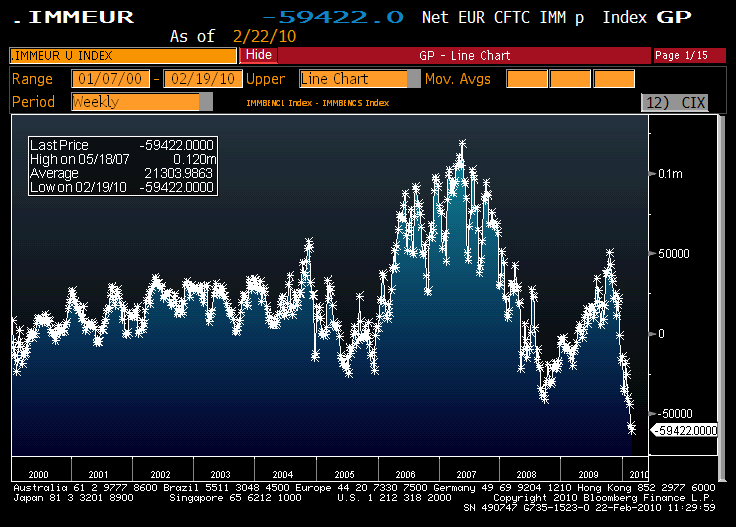
The EUR will be helped by the fact that speculative market, according to the CFTC IMM data, holds record short positions in the EUR (as of the week ended 16 February) giving plenty of potential for short-covering.   The more timely Tokyo Financial Exchange (TFX) data also reveals that positioning in EUR/JPY has continued to be scaled back.  

CFTC Commitment of Traders (IMM) data – Net EUR speculative positioning

EUR/USD bounced smartly from its lows around 1.3444 on Friday, partly reflecting some short covering and the drop in FX volatility suggests the market is more comfortable with EUR/USD around these levels.  A positive IFO survey and improved risk appetite could see EUR/USD test resistance around 1.3774, its 20 day moving average, over coming days.  Ongoing Greek concerns suggest that any EUR bounce will be limited, however. 

USD/JPY looks well supported and although data this week will suggest that exports are improving despite JPY strength, the relatively more aggressive stance of the Fed compared to the BoJ, long JPY positioning, and improved risk appetite, give plenty of scope for the JPY to extend losses, with technical USD/JPY support seen around 91.28.

Tarnishing The Euro (Part 2)

Will Europe come to the rescue of one its own?  The markets are still not entirely convinced.  Although EU officials spurred on by France and Germany agreed that some form of support was needed the lack of detail came as a disappointment.   Differences in opinion on how help should be provided meant that markets had nothing concrete to digest aside from a general agreement to provide assistance if needed. 

The EU validated Greece’s plans to cut its budget deficit by 4% this year but clearly backed away from committing taxpayers’ money to the country given the potential public backlash that supporting a country widely believed to have fudged its way into the EMU, would involve.   The end result was a further sell-off in the EUR although equity markets showed a bit more resilience which prevented a sharper fall in EUR/USD. 

Risk currencies generally are putting in firmer performances, with the AUD helped in part by the shockingly strong employment report and higher commodity prices.  The AUD and to a lesser extent the NZD are likely to continue to bask in the warm glow of these factors, with AUD/USD setting its sights on technical resistance around 0.8944.  EUR/USD is the weakest link and continues to trend lower, with strong technical support seen around 1.3583.

Asian currencies on the up

The third quarter of 2009 has proven to be another negative one for the US dollar.  Over the period the dollar index fell by over 4%.  The only major currency to lose ground against the dollar over this period was the British pound.  Most other currencies, especially the so called “risk currencies” which had come under huge pressure at the height of the financial crisis, registered strong gains led by the New Zealand dollar, Swedish krona and Australian dollar.  Although the euro also strengthened against the dollar it lagged gains in other currencies over the quarter.

Asian currencies also registered gains against the dollar in Q3 but to a lesser extent than G10 currencies.  Asian currency appreciation was led by the Korean won, Indonesian rupiah and Singapore dollar, respectively.  The under performer over Q3 was the Indian rupee which actually depreciated against the US dollar slightly.  The reason for the smaller pace of appreciation for most Asian currencies was due mainly to intervention by Asian central banks to prevent their respective currencies from strengthening too rapidly, rather than due to any inherent weakness in sentiment.

In fact, Asian currencies would likely be much stronger if it wasn’t for such FX interventions.  A good indication of the upward pressure on Asian currencies can be found from looking at the strength of capital inflows into local stock markets over recent months.  South Korea has registered the most equity capital inflows so far this year, with close to $20 billion of flows into Korean equities year to date but in general most Asian stock markets have registered far stronger inflows compared with last year.   

For the most part, balance of payments positions are also strong.  For example, South Korea recorded a current account surplus of $28.15 billion so far this year, compared to a deficit of $12.58bn over the same period last year.  This is echoed across the region.  Although surpluses are expected to narrow over coming months due mainly to a deterioration in the terms of trade, the overall health of external positions across the region will remain strong and supportive of further currency appreciation.  

The outlook for the final quarter of 2009 is therefore likely to be positive for Asian currencies, with the US dollar set to weaken further against most currencies.  Some risk will come from a potential reversal in global equity market sentiment but overall, further improvements in risk appetite will support capital inflows into the region.  Capital will be attracted by the fact that growth in Asia will continue to out perform the rest of the world and yet again only interventions by central banks will prevent a more rapid appreciation of Asian currencies.