US Dollar On The Rise

There are plenty of US releases on tap this week but perhaps the most important for the USD will be the minutes of the April 26-27 Fed FOMC meeting. Taken together with speeches by Fed officials including Bernanke, FX markets will attempt to gauge clues to Fed policy post the end of QE2. The Fed’s stance at this point will be the major determinant of whether the USD can sustain its rally over the medium term. The lack of back up in US bond yields suggests that USD momentum could slow, with markets likely to move into wide ranges over coming weeks.

It is worth considering which currencies will suffer more in the event that the USD extends its gains. The correlation between the USD index and EUR/USD is extremely strong (even accounting for the fact that the EUR is a large part of the USD index) suggesting that the USDs gains are largely a result of the EUR’s woes. Aside from the EUR, GBP, AUD and CAD are the most sensitive major currencies to USD strength whilst many emerging market currencies including ZAR, TRY, SGD, KRW, THB, IDR, BRL and MXN, are all highly susceptible to the impact of a stronger USD.

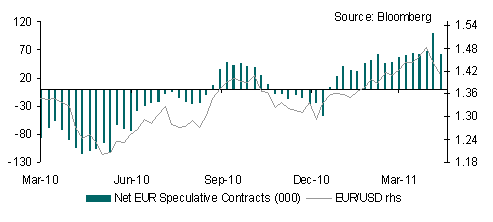
Robust Q1 GDP growth readings in both Germany and France helped to spur gains in the EUR but this proved short-lived. Sentiment for the currency has soured and as reflected in the CFTC IMM data long positions are being scaled back. Nonetheless, there is still plenty of scope for more EUR selling given ongoing worries about the eurozone periphery, which are finally taking their toll on the EUR. A break below EUR/USD 1.4021 would open the door for a test of 1.3980.
The eurogroup and ecofin meetings will be of interest to markets this week but any additional support for Greece is unlikely to be announced at this time. However, likely approval of Portugal’s bailout may alleviate some pressure on the EUR but any positive impetus will be limited. Even on the data front, markets will not be impressed with the German ZEW index of investor confidence likely to register a further decline in May.

Japanese officials have been shying away from further FX intervention by blaming the drop in USD/JPY over recent weeks on general USD weakness despite the move towards 80. However, this view is not really backed up by correlation analysis which shows that there is only a very low sensitivity of USD/JPY to general USD moves over recent months. One explanation for the strength of the JPY is strong flows of portfolio capital into Japan, with both bond and equity markets registering net inflows over the past four straight weeks.

This is not the only explanation, however. One of the main JPY drivers has been a narrowing in yield differentials. This is unlikely to persist with yield differentials set to widen sharply over coming months resulting in a sharply higher USD/JPY. As usual data releases are unlikely to have a big impact on the JPY this week but if anything, a further decline in consumer confidence, and a negative reading for Q1 GDP, will maintain the pressure for a weaker JPY and more aggressive Bank of Japan (BoJ) action although the BoJ is unlikely to shift policy this week.
Position Unwinding Boosts USD

The USD’s multi-month fall has come to an abrupt halt, with the currency registering gains in reaction to what appears to be a major position unwinding across asset markets, led by a drop in commodity prices.

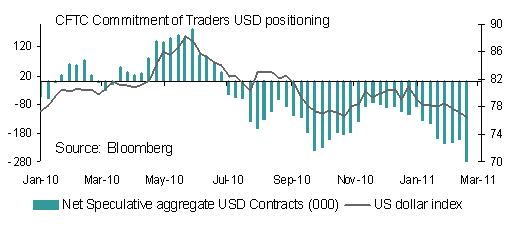
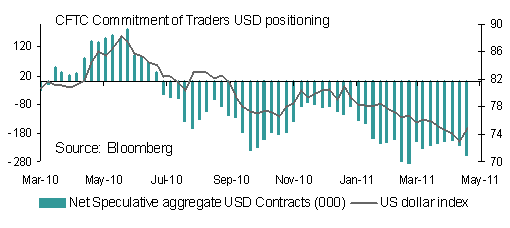
Will it continue? Whilst I am amongst the more bullish forecasters on the USD over the medium term, the current rally could prove to be short-lived in the absence of a shift in Federal Reserve rhetoric or end to quantitative easing (QE2). Nonetheless, the market had got itself very short USDs (as reflected in the CFTC IMM data as of early last week which showed an increase in net short positions) and the rally in the USD last week was likely spurred by major short-covering which could extend further into this week.

The move in the USD gained momentum as European Central Bank (ECB) President Trichet proved to be less hawkish than many expected in the press conference following last Thursday’s ECB meeting. Moreover, renewed worries about Greece at the end of last week, with a report in the German Der Spiegel, later denied by Greek officials, that the country was planning to leave the Eurozone dented the EUR,

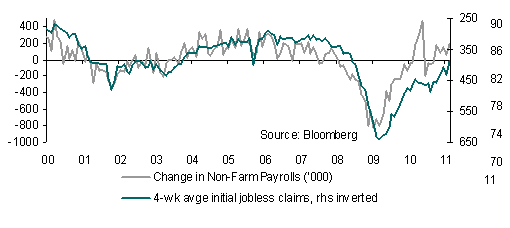
Taken together with the improving trend in US April non-farm payrolls (April registered +244k increase, with private payrolls 268k), these factors colluded to provide further positive stimulus to the USD and negative fallout on the EUR. The room for EUR downside is evident in the net long EUR speculative position, which rose to its highest since December 2007 as of 3rd May.

This week’s batch of US releases including March trade data, April retail sales and CPI, are unlikely to result in a reversal in last week’s trend though a trend like reading for core CPI, with the annual rate below the Fed’s comfort zone will reinforce expectations of dovish Fed policy being maintained, which could inject a dose of caution into the USD’s rally.

Against the background of a likely widening in the US trade deficit in March there will plenty of attention on the annual strategic and economic dialogue beginning today, with markets interested in discussions on Chinese worries about the gaping US fiscal deficit and US concerns about China’s exchange rate policy.

Greece’s denial of plans to leave the eurozone and discussions over a further adjustment to Greece’s bail out package, may help limit any drop in the EUR this week though it will by no means mark the end of such speculation about the periphery especially with this weeks’ Q1 GDP data releases across the eurozone likely to further highlight the divergence between the core and the periphery even if the headline eurozone reading rebounds strongly as we expect.

In the UK the Bank of England Quarterly Inflation Report will be the main influence on GBP. Downward growth revisions will play into the view that inflation will eventually moderate, capping expectation of higher interest rates over the coming months. However, the likely upward revision to near term inflation forecasts will help limit any damage to GBP.

GBP has lost ground to the USD but it should be noted that it has outperformed the EUR over recent days, reversing some of the recent run up in EUR/GBP. Given that EUR sentiment is likely to remain fragile this week, GBP may continue to capitalise, with a test of EUR/GBP 0.8672 on the cards.

US Dollar On A Slippery Path

The USD has been a on a slippery path over recent weeks, weighed down by adverse interest rate differentials despite improving US economic data. Adding to the run of encouraging US data releases the February jobs report revealed a 192k increase in jobs and a drop in the unemployment rate to 8.9%.

In particular the Fed’s dovish tone highlights that whilst asset purchases under QE2 will stop at the end of June, the failure to hit the Fed’s dual mandate of maximum employment and stable prices, implies that the Fed Funds rate will not be hiked for a long while yet. This dovish slant has undermined the USD to the extent that USD speculative positioning as reflected in the CFTC IMM data dropped to all time low in the week to 1 March. There is certainly plenty of scope for short-covering but the market is no mood to buy the USD yet.

This week’s releases will provide less direction, with a slight widening in the trade deficit likely in January, a healthy gain in February retail sales and a small drop in the preliminary reading of March Michigan sentiment.

In contrast, even the generally hawkish market expectations for the European Central Bank (ECB) proved too timid at last week’s Council meeting as Trichet & Co. strongly implied via “strong vigilance” that the refi rate would be hiked by 25bps in April. EUR/USD lurched higher after the ECB bombshell breaking the psychologically important 1.4000 barrier but appeared to lose some momentum at this level. Should EUR/USD sustain a break of 1.4000, the next level of resistance is at 1.4281 (November high), with support seen around 1.3747.

The lack of major eurozone data releases this week, with only industrial production data in Germany and France of interest, suggests that EUR may consolidate over the short-term with the main interest on the informal Heads of State meeting at the end of the week to determine whether credible plans can be drawn up to restore confidence in the periphery.

This week it is the turn of the Bank of England (BoE) to decide on monetary policy but unlike the ECB we do not expect any surprises with an unchanged decision likely. Further clues will only be available in the Monetary Policy Committee (MPC) minutes on 23 March. However, markets may be nervous given that it could feasibly only take another two voters aside from the three hawkish dissenters last month, to result in a policy rate hike. Notably one possible hawkish dissenter, Charles Bean did not sound overly keen on higher rates in a speech last week, a factor that weighed on GBP alongside some weaker service sector Purchasing Managers Index (PMI) data.

UK manufacturing data will be the main data highlight of the calendar but this will be overshadowed by the BoE meeting. GBP/USD could continue to lag the EUR and given a generally bullish EUR backdrop, our preferred method of playing GBP downside remains via a long EUR/GBP position.

Global Themes

It’s definitely been a strange start to the year, with markets taking plenty of time to get their bearings. Some general themes have developed but none have provided clear direction. As a result, the path over coming weeks and months is likely to remain highly volatile and in this respect, currencies, equities and bonds will continue to see strong gyrations.

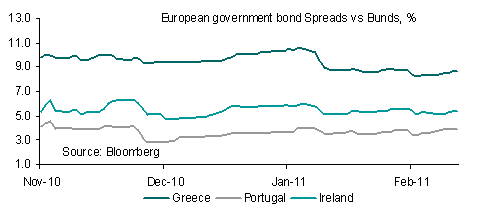
One theme that has been evident since the start of the year is an improvement in sentiment towards the eurozone periphery as hopes of an enlargement/extension of the European Union bailout fund (EFSF) have increased. This is a key reason why the EUR has strengthened this year although nervousness on this front appears to have returned over recent days (note the recent widening in peripheral bond spreads, drop in EUR and European Central Bank purchases of Portuguese debt). It seems that a lot of good news has already been discounted in relation to the eurozone periphery and now markets are in wait and see mode for the EU Council meeting on 24/25 March. There is a strong chance that eventually market expectations will prove overly optimistic and the EUR will drop but more on that later.

The second theme is global inflation concerns, driven by higher food and energy prices. Certainly this has had an impact on interest rate expectations and in some cases resulted in a hawkish shift in central bank language, notably in the eurozone and UK. Although European Central Bank (ECB) President Trichet has toned down his comments on tighter monetary policy compared to the more hawkish rhetoric following the last ECB council meeting, expectations for monetary tightening in the eurozone still look overly hawkish, with a policy rate hike currently being priced in for August/September this year, which looks way too early. The EUR has benefitted from the relative tightening in eurozone interest rate expectations compare to the US but will suffer if and when such expectations are wound down.

Elsewhere in many emerging markets the impact of higher food prices is finding its way even more quickly into higher inflation, forcing central banks to tighten policy. In Asia, the urgency for higher rates is even more significant given that real interest rates (taking into account inflation) are negative in many countries. China has accelerated the pace of its rate hikes over recent months and looks set to continue to tighten policy much further to combat inflation. In India, worries about inflation and the need for further monetary tightening have clearly weighed on equity markets, with more pain to come. Although not the sole cause by any means, in the Middle East and Africa higher food prices are feeding social tensions such as in Egypt.

Another clear theme that has developed is the improvement in US economic conditions. The run of US data over recent months has been encouraging, confirming that the economy is gaining momentum. Even the disappointing January non-farm payrolls report has not dashed hopes of recovery, with many other job market indicators pointing to strengthening job conditions such as the declining trend in weekly US jobless claims. Manufacturing, business and consumer confidence measures have strengthened whilst credit conditions are easing, albeit gradually. The US economy is set to outperform many other major economies this year, especially the eurozone, which will be beset with a diverging growth outlook between northern and southern Europe.

Although the US dollar has not yet benefitted from stronger US growth given the still dovish tone of the Fed and ongoing asset purchases in the form of quantitative easing, the rise in US bond yields relative to other countries, will likely propel the dollar higher over 2011 after a rocky start over Q1 2011. In contrast, the EUR at current levels looks too strong and as noted above, hopes of a resolution of eurozone peripheral problems look overdone. EUR/USD levels above 1.3500 provide attractive levels to short the currency. Other growth currencies that will likely continue to do well are commodity currencies such as AUD, NZD and CAD, whilst the outlook for Asian currencies remains positive even despite recent large scale capital outflows. The JPY however, will be one currency that suffers from an adverse yield differential with the US as US bond yields rise relative to Japan.

Econometer.org has been nominated in FXstreet.com’s Forex Best Awards 2011 in the “Best Fundamental Analysis” category. The survey is available at http://www.surveymonkey.com/s/fx_awards_2011

Data and earnings focus

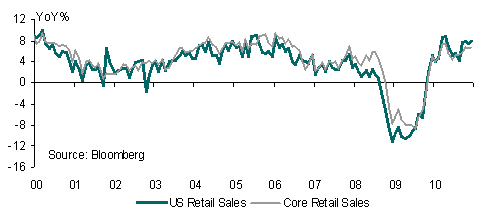
Friday’s round of US data were generally upbeat, highlighting that consumer spending is coming back to life. Inflation pressures however, remain benign at least on the core reading highlighting the Fed’s concern that inflation is running below the level consistent with its mandate. In other words it will be a long time, probably late into 2012 before policy rates increase.

While the Fed is no hurry to raise rates despite a few hawkish rumblings within the FOMC the European Central Bank (ECB) in contrast appears to have become more eager to pull the trigger for higher rates. ECB President Trichet’s hawkish press conference last week set the cat amongst the pigeons and marked a clear shift in ECB rhetoric towards a more hawkish stance.

A very big problem for the ECB is that the eurozone economy is not performing along the lines that its hawkish rhetoric would suggest, especially in the periphery. Growth momentum in the core in contrast, as likely reflected in the January ZEW investor confidence and IFO business confidence survey data this week in Germany, remains positive. Both surveys are likely to stabilize at healthy levels but how long can the likes of Germany drag along the eurozone periphery?

There will be relatively more attention on the meeting of Eurogroup/Ecofin officials, with focus on issues such as enlarging the size of the European Financial Stability Facility (EFSF) bailout fund and development of a “comprehensive plan” to contain the eurozone crisis. Don’t look for any conclusive agreements as this may have to wait until the European Union (EU) Council meeting on 4 February assuming (optimistically given ongoing German resistance) some agreement can even be reached.

Following the success (albeit at relatively high yields) of the eurozone debt auctions last week, sentiment for peripheral debt will face further tests this week in the form of debt sales in Spain, Belgium and Portugal.

The US Martin Luther King Jr. holiday will result in a quiet start to the week for markets but there will be plenty to chew on. This week’s key earnings reports include several banks scheduled to release Q4 earnings. Financials are a leading sector in the rally in equities at present and these earnings will be critical to determine whether the rally has legs.

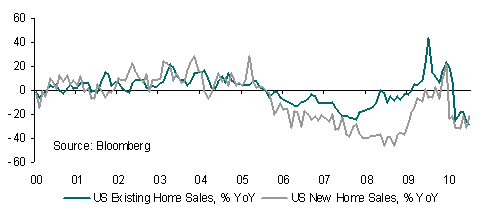
The US data slate includes January manufacturing surveys in the form of the Empire and Philly Fed, both of which are likely to post healthy gains whilst existing home sales are also likely to rise. This will not change the generally weak picture of the US housing market, with high inventories and elevated foreclosures characterizing conditions. As if to prove this, housing starts are set to drop in December. On the rates front, the Bank of Canada is likely to keep its policy rates on hold this week.

After coming under pressure last week much for the USD will depend on the eurozone’s travails to determine further direction. Concrete evidence of progress at the Ecofin may bolster the EUR further, with resistance seen around 1.3500 but don’t bank on it. The ability of eurozone officials to let down often lofty expectations should not be ignored. In any case following sharp gains last week progress over coming days for the EUR will be harder to achieve.