Risk off mood

A ‘risk off’ tone is quickly permeating its way through the market psyche as tensions surrounding the eurozone periphery reach fever pitch. This is reflected in the sharp jump in equity volatility as indicated by the VIX ‘fear’ gauge. Equity markets and risk trades in general look set to remain under pressure in the current climate.

Moreover, the EUR which is finally succumbing to bad news about the periphery will continue to face pressure over the short-term. Against this background economic data will likely be relegated to the background this week but it worth noting that what data there is on tap, is likely to send a weaker message, with data such as durable goods orders in the US as well as various purchasing managers indices (PMI) data in the eurozone today likely to show some slippage.

The Greek saga remains at the forefront of market attention, with restructuring speculation remaining high despite various denials over the weekend by Greek and European Central Bank (ECB) officials. News that Norway has frozen payments to Greece, whilst Fitch ratings agency’s downgrades of Greece’s ratings by 3 notches and S&P’s downgrade of Italy’s ratings outlook to negative, have all contributed to the malaise afflicting the periphery.

This weekend’s local election in Spain in which Prime Minister Zapatero and his Socialist Party suffered its worst defeat in more than 30 years leading to a transfer of power in the Spanish regions, will lead to concerns about the ability of the government to carry out much needed legislative changes.

It is difficult to see any improvement in sentiment towards the peripheral Europe and consequently the EUR over the short-term. In Greece, Prime Minister Papandreou will attempt to push through further unpopular austerity measures through parliament this week in advance of a 5th bailout tranche of EUR 12 billion scheduled for next month. This comes at a time when opinion polls show the government losing more support and 80% of those surveyed saying they would not accept more austerity measures.

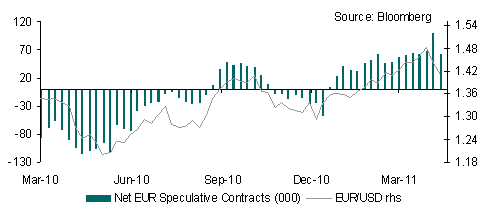
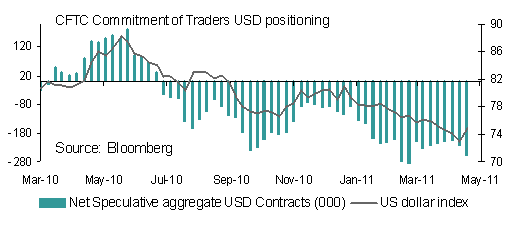
The deterioration in sentiment for the EUR has been rapid as reflected in the CFTC IMM data, with net long speculative positions now at their lowest since 15 February and heading further downhill. Conversely, USD short covering has been significant though there is still a hefty USD short overhang, which points to more USD short covering as EUR sentiment sours.

Nonetheless, the USD still has plenty of risks hanging over it including the fact that it still suffers from an adverse yield differential (note that 2-year Treasury yields have fallen to the lowest since 6 December 2010). Safe haven currencies in particular CHF are the key beneficiaries and notably EUR/CHF touched a record low around 1.2354 and is showing little sign of any rebound.
US Dollar On The Rise

There are plenty of US releases on tap this week but perhaps the most important for the USD will be the minutes of the April 26-27 Fed FOMC meeting. Taken together with speeches by Fed officials including Bernanke, FX markets will attempt to gauge clues to Fed policy post the end of QE2. The Fed’s stance at this point will be the major determinant of whether the USD can sustain its rally over the medium term. The lack of back up in US bond yields suggests that USD momentum could slow, with markets likely to move into wide ranges over coming weeks.

It is worth considering which currencies will suffer more in the event that the USD extends its gains. The correlation between the USD index and EUR/USD is extremely strong (even accounting for the fact that the EUR is a large part of the USD index) suggesting that the USDs gains are largely a result of the EUR’s woes. Aside from the EUR, GBP, AUD and CAD are the most sensitive major currencies to USD strength whilst many emerging market currencies including ZAR, TRY, SGD, KRW, THB, IDR, BRL and MXN, are all highly susceptible to the impact of a stronger USD.

Robust Q1 GDP growth readings in both Germany and France helped to spur gains in the EUR but this proved short-lived. Sentiment for the currency has soured and as reflected in the CFTC IMM data long positions are being scaled back. Nonetheless, there is still plenty of scope for more EUR selling given ongoing worries about the eurozone periphery, which are finally taking their toll on the EUR. A break below EUR/USD 1.4021 would open the door for a test of 1.3980.

The eurogroup and ecofin meetings will be of interest to markets this week but any additional support for Greece is unlikely to be announced at this time. However, likely approval of Portugal’s bailout may alleviate some pressure on the EUR but any positive impetus will be limited. Even on the data front, markets will not be impressed with the German ZEW index of investor confidence likely to register a further decline in May.

Japanese officials have been shying away from further FX intervention by blaming the drop in USD/JPY over recent weeks on general USD weakness despite the move towards 80. However, this view is not really backed up by correlation analysis which shows that there is only a very low sensitivity of USD/JPY to general USD moves over recent months. One explanation for the strength of the JPY is strong flows of portfolio capital into Japan, with both bond and equity markets registering net inflows over the past four straight weeks.

This is not the only explanation, however. One of the main JPY drivers has been a narrowing in yield differentials. This is unlikely to persist with yield differentials set to widen sharply over coming months resulting in a sharply higher USD/JPY. As usual data releases are unlikely to have a big impact on the JPY this week but if anything, a further decline in consumer confidence, and a negative reading for Q1 GDP, will maintain the pressure for a weaker JPY and more aggressive Bank of Japan (BoJ) action although the BoJ is unlikely to shift policy this week.

Position Unwinding Boosts USD

The USD’s multi-month fall has come to an abrupt halt, with the currency registering gains in reaction to what appears to be a major position unwinding across asset markets, led by a drop in commodity prices.

Will it continue? Whilst I am amongst the more bullish forecasters on the USD over the medium term, the current rally could prove to be short-lived in the absence of a shift in Federal Reserve rhetoric or end to quantitative easing (QE2). Nonetheless, the market had got itself very short USDs (as reflected in the CFTC IMM data as of early last week which showed an increase in net short positions) and the rally in the USD last week was likely spurred by major short-covering which could extend further into this week.

The move in the USD gained momentum as European Central Bank (ECB) President Trichet proved to be less hawkish than many expected in the press conference following last Thursday’s ECB meeting. Moreover, renewed worries about Greece at the end of last week, with a report in the German Der Spiegel, later denied by Greek officials, that the country was planning to leave the Eurozone dented the EUR,

Taken together with the improving trend in US April non-farm payrolls (April registered +244k increase, with private payrolls 268k), these factors colluded to provide further positive stimulus to the USD and negative fallout on the EUR. The room for EUR downside is evident in the net long EUR speculative position, which rose to its highest since December 2007 as of 3rd May.

This week’s batch of US releases including March trade data, April retail sales and CPI, are unlikely to result in a reversal in last week’s trend though a trend like reading for core CPI, with the annual rate below the Fed’s comfort zone will reinforce expectations of dovish Fed policy being maintained, which could inject a dose of caution into the USD’s rally.

Against the background of a likely widening in the US trade deficit in March there will plenty of attention on the annual strategic and economic dialogue beginning today, with markets interested in discussions on Chinese worries about the gaping US fiscal deficit and US concerns about China’s exchange rate policy.

Greece’s denial of plans to leave the eurozone and discussions over a further adjustment to Greece’s bail out package, may help limit any drop in the EUR this week though it will by no means mark the end of such speculation about the periphery especially with this weeks’ Q1 GDP data releases across the eurozone likely to further highlight the divergence between the core and the periphery even if the headline eurozone reading rebounds strongly as we expect.

In the UK the Bank of England Quarterly Inflation Report will be the main influence on GBP. Downward growth revisions will play into the view that inflation will eventually moderate, capping expectation of higher interest rates over the coming months. However, the likely upward revision to near term inflation forecasts will help limit any damage to GBP.

GBP has lost ground to the USD but it should be noted that it has outperformed the EUR over recent days, reversing some of the recent run up in EUR/GBP. Given that EUR sentiment is likely to remain fragile this week, GBP may continue to capitalise, with a test of EUR/GBP 0.8672 on the cards.

EUR boosted, USD under pressure

Market attention remains fully focussed on events in Japan especially related to the country’s nuclear facilities. Risk aversion has spiked higher as a result, with ongoing Middle East tensions adding to the risk off tone. CHF is a key beneficiary of safe haven demand but the picture for JPY is obscured by repatriation expectations on one hand and FX intervention risks/Bank of Japan liquidity injections on the other, keeping USD/JPY clsoe to the 82.00 level. In contrast the AUD is vulnerable to a drop below parity with the USD on Japan worries, especially as Australia is a key destination for Japanese investment and therefore potential for reversal of such flows if Japanese institutions repatriate funds.

The EUR recovered over recent days as worries about the eurozone periphery ease and peripheral bonds spreads narrow. It is only a matter of time before overly long market positioning catches up with the EUR especially as the prospects of further interest rate support to the currency looked limited; markets have already priced in 75bps of policy rate hikes in the eurozone this year, which looks appropriate. It is difficult to see markets pricing in any more tightening than this over coming weeks. Despite its bounce back EUR/USD will struggle to break resistance around 1.4036.

Markets will digest the fallout from the informal EU leaders meeting last Friday which prepared the groundwork for the official meeting on 24/25 March. The initial reaction of the EUR appears to be positive but there is a significant risk of disappointment if the outcome of the meeting on 24/25 March does not live up to expectations. Indeed although Friday’s meeting resulted in an agreement in principle of a new “pact for the Euro” much will depend on the eventual details later this month.

Leaders also agreed on lowering interest rates to Greece by 100bps, and in principle enlarging the scope of the European Financial Stability Facility (EFSF) bailout fund to EUR 440 billion. The main positive surprise was opening the door for the fund to purchase eurozone debt. Data releases will offer little support to the EUR this week, with limited gains in the March German ZEW investor confidence survey today likely to leave markets unperturbed.

The USD’s gains last week proved short-lived and the currency will be tested by another relatively dovish Fed FOMC statement today and a benign reading for core CPI inflation in February. The Fed FOMC meeting is unlikely to deliver any changes to the Fed’s stance and whilst there has recently been some speculation that the Fed will soon remove its “extended period” comment, this is unlikely to happen any time soon. The statement will remind markets that the Fed is in no rush to alter its policy settings, an outcome that may limit the ability of the USD to strengthen this week even if data releases continue to remain on the positive side, including manufacturing survey and industrial production over coming days.

Eurozone peripheral tensions

The USD index remains under pressure but will likely continue to consolidate. The USD continues to be undermined by adverse interest rate differentials and is gaining little support from rising risk aversion. One factor that will help dictate USD direction over coming months is the prospects for further quantitative easing once QE2 ends.

Fed officials offered varied views on the subject. Dallas Fed President Fisher hinted he would support cutting short asset purchases before the end of June, whilst Atlanta Fed President Lockhart noted he was “very cautious” about further asset purchases. Meanwhile Chicago Fed President Evans noted that he believes the hurdle for altering the asset purchase plan is “pretty high”.

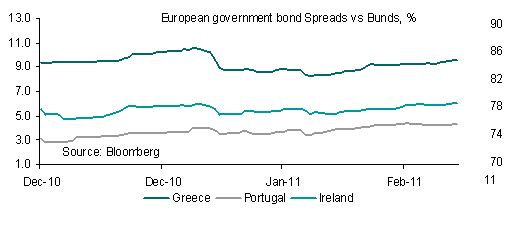
Although there is a lack of first tier data releases in the eurozone this week there is certainly plenty for markets to chew on in terms of peripheral country issues, which may just prevent the EUR from extending its gains. Eurozone peripheral debt spreads have undergone a renewed widening over recent weeks as debt fears have increased and worries that Portugal may follow Ireland and Greece in needing a bailout have risen.

Meanwhile news that Ireland’s incoming government will introduce legislation allowing the restructuring of some senior bank bonds, will add to tensions. Meanwhile, the downgrading of Greece’s government bond ratings to B1 from Ba1 dealt another blow sentiment following hot on the heels of Fitch’s downgrade of Spain’s outlook to negative although the EUR proved resilient to the news. EUR/USD continues to look as though it will consolidate around the 1.4000 level, but worsening sentiment towards the periphery may open up downside as the EUR’s resilience fades.

Upward revisions to eurozone growth and inflation forecasts and of course a hawkish shift in eurozone interest rate expectations may have justified the EUR move higher over recent weeks. However, there does not seem to be much that will provide the stimulus for further gains from current levels.

The market has already priced in an interest hike as early as next month’s European Central Bank (ECB) meeting and further tightening thereafter. The risk now appears asymmetric skewed to the downside especially if tensions between the eurozone core and peripheral countries deepen. How long the EUR can ignore such tensions?

It’s not only the eurozone periphery that should worry about ratings. Japan’s ratings agency R&I has warned that it may be forced to cut Japan’s sovereign ratings before April’s local elections due to current political problems. R&I’s concern revolve around the potential for political problems to delay fiscal reforms. As usual the JPY remains unmoved by political issues and is moving to the stronger side of its recent range against the background of elevated risk aversion.

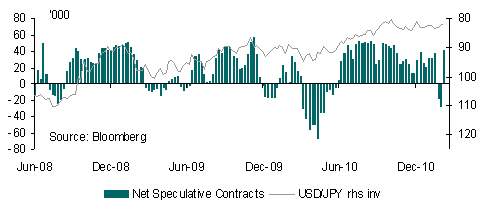
Although the JPY has not been particularly sensitive to risk over recent months shorter-term correlations shows that its sensitivity has increased. Given that Middle-East tensions do not appear to be easing the JPY will remain well supported. Indeed, speculative positioning data reveals the highest JPY net long position since November 2010. As risk appetite improves JPY positioning will be pared back but this is unlikely to be imminent, with USD/JPY set to remain close to support around 81.10.